
Current
Fashion and Textiles
This is a challenging, glamorous and exciting industry.
This two-year Fashion Design course is an extremely practical course that will provide the learners with the theoretical and practical skills required to open up a wide array of career paths and job opportunities.
The learners will design and create a number of garments and each year. The learners hold a fashion show where they will showcase their own designs. Lecturers are active in the industry which means learners will be exposed to the latest trends and techniques.
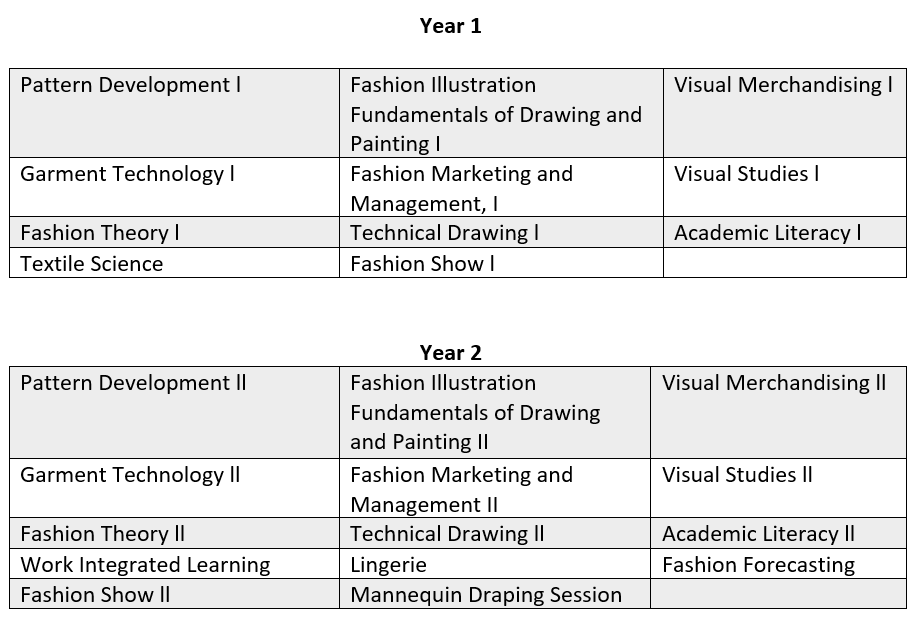
The following subjects are included:
The purpose of this Fashion Design programme is to develop problem finders and problem solvers that have the competence to work independently as entrepreneurial fashion designers. The objective of this course is to:
- Apply integrated knowledge and advanced conceptual thinking skills to solve complex fashion design problems;
- Use a range of design methods, processes and techniques to create, present and argue for professional fashion designs;
- Enable learners to demonstrate knowledge of design history and theory in broader context and fashion design history and theory in discipline specific context, and to conduct design criticism and research.
How is Diploma in Fashion Design Course Beneficial?
The course is beneficial for those who wish to opt for fashion designing to enter the commercial world of fashion or even for the personal satisfaction of possession the formal knowledge of clothing design, the course is aimed at linking creative exploration with technology and market understanding.Diploma in Fashion Design Employment Areas
- Colleges & Universities
- Boutiques
- Garment Store Chains
- Several Export Houses
- Fashion Show Organizers
- Jewellery Houses
- Textile Mills
- Media Houses
- Leather Companies
Diploma in Fashion Design Career Opportunities and Job Types
The programme will equip you with the necessary knowledge and skills for a design career in the fashion industry, including: • Retail Manager• Assistant Designer
• Stylist
• Entrepreneur
• Fashion Co-ordinator
• Accessory Designer
• Designer
• Pattern Engineer
• Fashion Choreographer
• Pattern Cutter and Grader
• Fashion Merchandiser
• Quality Controller
• Production Manager
• Design Manager
• Fashion Stylist
Fashion Design Syllabus
Syllabus for the Fashion Design Course is split into 3 modules. In the first module, you learn the basic concepts of designing, introduction to various parts of the sewing machine, different types of tools used for designing, how to cut patterns on paper, elements of fashion, the evolution of fashion, fashion cycle, basic embroidery stitches etc. This module also teaches you different methods to figure out common issues in a sewing machine and how to rectify them.Second module starts with the psychology of colours. Further you learn principles of designs exploring the history of various costumes in different parts of the world. It also covers different types of sleeves, collars, pockets, plackets, necklines, pleats and tucks.
As you progress towards the 3rd module, you learn step by step procedures in a garment industry. By the end of this course you will be capable of designing and executing your own designs.
Key Subjects in Fashion Designing
-
Pattern Development
Pattern Making is the art of controlling, shaping and moulding a piece of fabric to comply with one or more curves of the human figure. It is the major bridge between design and production. It deals with patterns, grains and different formulas to make pieces of clothing for various body sizes. It starts with a prototype (sketch) which is turned into a garment via a pattern which interprets the design in the form of the garment components. It is very useful for mass production of garments as it is based on standard measurements and formulas.
Pattern making helps you in obtaining a perfect fit for a garment and saves a lot of time for repeated usage. The procedure known as "Grading" can be used for making new patterns, proportionately larger or smaller in size which saves time and effort. -
Fashion Illustration Fundamentals of Drawing and Painting
Illustration also known as Sketching or Fashion Illustration is the art of communicating ideas into a visual form with the help of drawings, sketching and coloring. As soon as an idea develops in the mind of a fashion designer, he sketches it on a piece of paper. Further necessary changes are made to this sketch, to form a perfect design.
This illustration makes it easier and helps to communicate your ideas with your team. It helps in reducing wastage as designers visualize thoughts and make alterations before going to actual clothing. Flat sketches are black and white drawings of garments with details like stitching, styling etc. and later the colors are added to represent the complete garment. Nowadays Adobe Illustrator is included as the part of Computer-aided design (CAD) that helps artists to create professional standard vector graphics. -
Design Development
The Design Development literally means a set of steps of how to ideate a design. It involves research, analysis, visualization and through understanding of the customer. Design concept helps you in developing design strategies to approach garment design in a conceptual way. It allows you to understand a variety of design processes which enhances your imagination to create better designs. Through discussions, conceptualization and inspiration you gain ability to visualize a garment 3-dimensionally and helps students to think and re-explore conceptual design ideas with respect to the current fashion trends.
-
Garment Technology/Construction
Clothing Construction also known as Garment Construction is basically the skill to sew a garment. It requires in-depth knowledge about fabrics, principles of construction to make it fit well. A costume is constructed by cutting the fabric into different parts according to a finalized pattern which fits the human form and then joining the different parts together by sewing.
Clothing construction includes cutting, pattern use, fabric layout, machine sewing, hand stitches as well as finishing to create perfectly good looking garments. -
Applied Techniques - Surface Ornamentation
Surface Ornamentation is the decorative art used on the surface of the garment which makes the garment look more attractive and beautiful. The main idea of decorating fabric is to add an element of interest. Sequins, beads, threads, mirrors, wires, pipes or tubes, buttons, nets etc. are the materials used to enhance the look of a costume. It not only includes different kind of traditional embroideries and stitches but also focuses on other areas like ribbon work, mirror work, fabric painting, warli painting, tie and dye, patch work etc. Additions to fabric can take the form of nearly anything, from the addition of pure stitching to other fabrics, glasses, precious stones, metals, wood and animal products.
-
Textile Science
Textile Science deals with production and properties of various synthetic, natural fibres, apparels, fabrics and different types of yarns. It helps you to learn more about the manufacturing aspects of clothing and textiles. You also get an in-depth knowledge about the various testing techniques for different types of fabrics. The other areas where Textile Science focus are sustainability, waste management and keeping the environment safe by the use of eco-friendly materials. When it comes to textile designing you also learn different types of printing and dyeing methods.
-
Applied Techniques - Garment Industry
Garment Industry is the complete life-cycle of a garment. It is responsible for taking a raw material like cotton, wool or silk and spinning it into yarn that is later used to create a fabric. The process includes Spinning, Weaving, Dyeing, Printing, Finishing and manufacturing of garments. In this subject you get in-depth knowledge about the flow in a garment industry starting from starting from the initial stages of sketching an idea or a design. The next steps after sketching are pattern design, sample making, creating production pattern, grading, marker planning, spreading, cutting, sorting, bundling, sewing, inspection, pressing, finishing, final inspection and packing.
-
Fashion Theory - History of Costumes
The evolution of costumes began when humans needed a layer of protection from the climatic changes. The Chinese and the Greek play a major role in the theory of Origin of fashion. People started using animal skin and fur to protect their body from the cold atmosphere. The history what we know today has emerged after a long process of evolution. The evolution of costume changed drastically after the 1st World War. History of fashion generally considers fashion synonymous with stylistic change. In this subject you learn the history of Indian costume and traditional jewellery. It also covers details about the history of French, Greek, American and Egyptian costumes.
Activities & Other Events
Syllabus of Fashion Designing is not just the regular curriculum but it goes beyond the textbooks. Fashion Designing course at the KwaZulu Natal Arts Institute (PFD) we also provide activities outside the campus. The fashion world is moving at a great pace as each day starts with something new and all these updates cannot be included in the students' curriculum. Interactive learning experiences inside as well outside the classroom environment Brainstorming Sessions, Group activities such as Brainstorming are conducted to figure out a solution from generating ideas on a particular topic.Group activity makes it interesting as students join together to think critically and imaginatively to come up with solutions. Each student gets a chance to share his/her view points, discuss and clarify over other's thoughts. This helps in the development of practical thoughts and creative thinking which is most important to resolve issues.
Industrial visit is one of the most important part of the Fashion Designing course, during which students visit garment industries and get insight knowledge on the internal working environment of the company. It also provides an idea on how industries work and students learn useful information related to the practical aspects of the course which cannot be visualized from lectures in classrooms. It helps students to gain hands-on experience of the internal working environment. They learn how operations are executed in industries which resolves the gap between theoretical training and practical learning in a real-life environment. Students are also able to identify their prospective areas of work as they become more aware of industries practices and regulations. Industrial visits expand the outlook of students with exposure of different roles in various industries.